
In modern homes and commercial buildings, indoor water supply systems are usually buried deep under floors, walls, or ceilings. This creates a clean and tidy environment—but once a leak occurs, it can become extremely difficult to identify the source. Many users only realize the issue after noticing swollen floors, damp walls, or unusually high water bills. Traditional inspection methods rely heavily on guesswork, often requiring large-area demolition, which is costly, slow, and highly disruptive.
This was exactly the problem faced by a customer in Malaysia. Water marks started appearing on the floor of his living area, gradually spreading toward the wooden flooring. Unable to locate the source of the leak, the customer contacted a professional inspection team. The team used the PQWT-125C pipe leak detector, a high-precision acoustic device designed for indoor leak detection. The instrument successfully pinpointed the exact leak point, which was later verified through excavation—accurate and mistake-free.
This case documents the entire process and demonstrates the effectiveness of the PQWT-125C in real on-site conditions.
1. Early Signs of Trouble: Unexplained Moisture on the Indoor Floor
The customer first noticed a small wet patch on the floor near the kitchen-living room area. He wiped it dry several times, but the moisture kept returning. Over the next few days, the damp area expanded, and the edge of the wooden floor started to change color due to moisture absorption.
Because the leak was inside the house and not in common areas like bathrooms, the situation became even more confusing. A local plumber came to inspect the site but was unable to confirm the exact location. He suggested multiple possibilities—“This pipe might be leaking, or maybe it’s the cold-water line under the floor”—but the only solution he offered was large-scale demolition.
The customer realized that guessing would only lead to unnecessary damage and higher repair costs. To avoid blindly breaking tiles or flooring, he decided to book a professional inspection service equipped with a true pipeline leak detector.
2. Professional On-Site Inspection with PQWT-125C
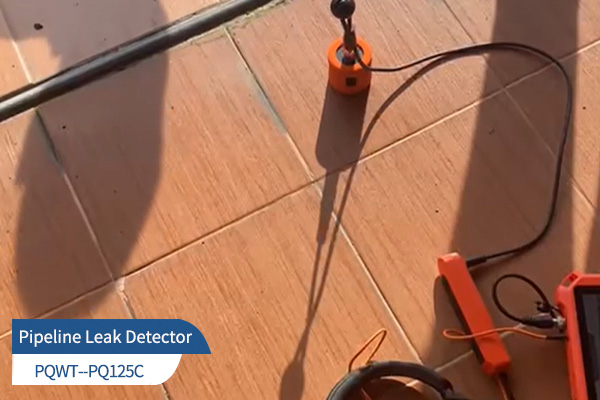
The technical team arrived with floor plans and pipe layout information. After reviewing the moisture area and possible supply routes, they prepared to begin the acoustic inspection using the PQWT-125C.
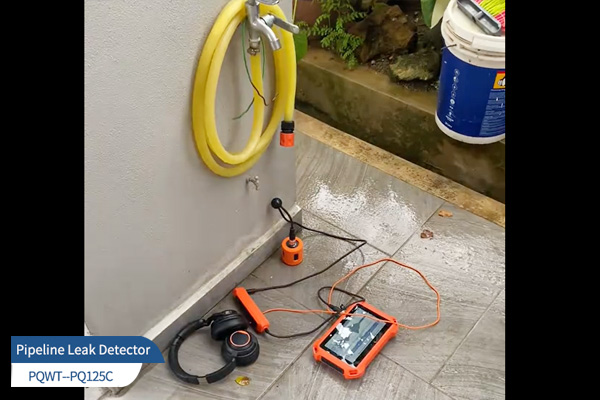
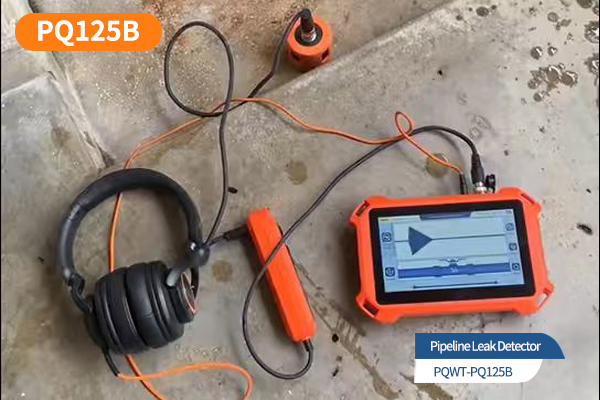
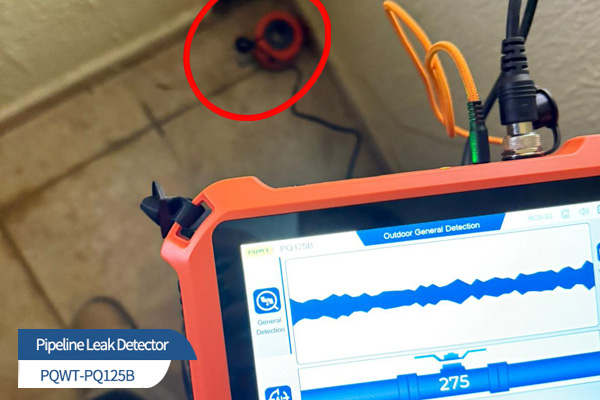
The PQWT-125C operates by capturing subtle sound vibrations produced by leaking pipes. These acoustic signals are processed and displayed on the device screen, allowing the operator to analyze intensity differences and identify the leak point.
The inspection steps included:
Closing the main supply valve
Adjusting pressure in the suspected pipeline
Scanning the floor area with the acoustic probe
Comparing signal strengths across multiple points
Filtering environmental noise and identifying abnormal peaks
Within minutes, the instrument began to show noticeable signal changes.
3. Leak Signal Detected: The PQWT-125C Pinpoints the Location
As the operator scanned more positions, the PQWT-125C displayed a stable and repeatable peak at a specific spot near the center of the living area. To ensure accuracy, the team repeated the scan from multiple directions—front, back, left, and right—each time showing the same increasing audio amplitude at the same point.
The inspection team concluded that the leak was located beneath the floor, on a cold-water supply pipe running between the living room and kitchen.
The customer was surprised because the visible water stains did not match the internal leak direction at all—yet the PQWT-125C detected the true source through acoustic analysis, something impossible by visual inspection alone.
4. Excavation and Verification: The Leak Revealed Clearly
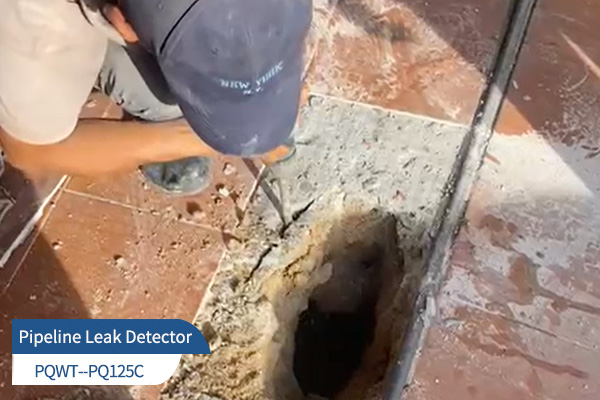
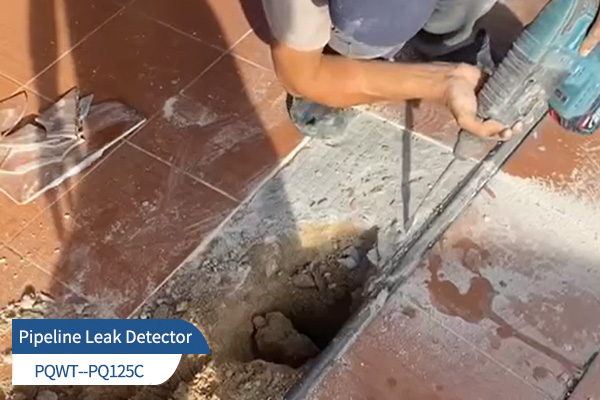
Following the marked position provided by the PQWT-125C, the repair team carefully removed a small section of flooring (roughly 40 × 40 cm). Once the concrete layer was partially removed, the pipe became visible.
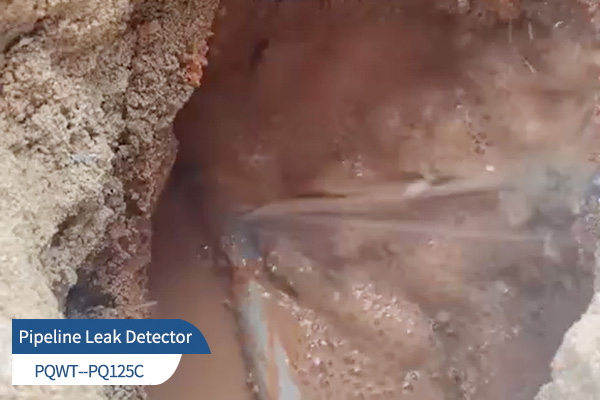
As expected, a small crack near the pipe bend was actively leaking water droplets.
The device’s detection accuracy was confirmed:
The difference between the predicted point and the actual leak was nearly zero.
The repair team replaced the damaged pipe section, sealed the opening, and restored the flooring. The entire repair process was fast, clean, and controlled—thanks to precise leak localization.
5. How Accurate Leak Detection Saves Time, Money, and Stress
The PQWT-125C significantly changed what could have been a major renovation into a simple, targeted repair. Compared with traditional trial-and-error methods, its advantages were clear:
1. Precision Without Destruction
Only a small area needed to be opened—no need to remove entire floors.
2. Rapid Detection
The location was identified in under an hour, minimizing downtime.
3. Effective Across Multiple Floor Materials
Tile, wood flooring, cement—PQWT-125C still delivers stable detection.
4. Suitable for All Common Indoor Pipelines
PVC, PPR, PE, galvanized pipes, and more.
For the customer, the biggest relief was avoiding unnecessary expenses. A job that could have turned into a full flooring replacement was reduced to a localized repair.
6. Conclusion: Precision Is the Future of Indoor Leak Detection
This Malaysia case demonstrates the reliability and real-world performance of the PQWT-125C pipe leak detector. For indoor leak problems—especially those hidden under floors or behind walls—experience alone is not enough. Only professional detection equipment can provide the accuracy needed to resolve the issue efficiently.
With its advanced acoustic detection capabilities, stable performance, and suitability for a wide range of indoor environments, the PQWT-125C has become a trusted solution for homeowners, property managers, and maintenance teams.
When facing unexplained indoor moisture, rising water bills, or hidden leaks, remember:
Precise detection = smaller excavation = lower cost = faster repair
If you are also dealing with an indoor leakage issue, choosing a professional pipeline leak detector like the PQWT-125C is the smartest, fastest, and most cost-effective solution.